
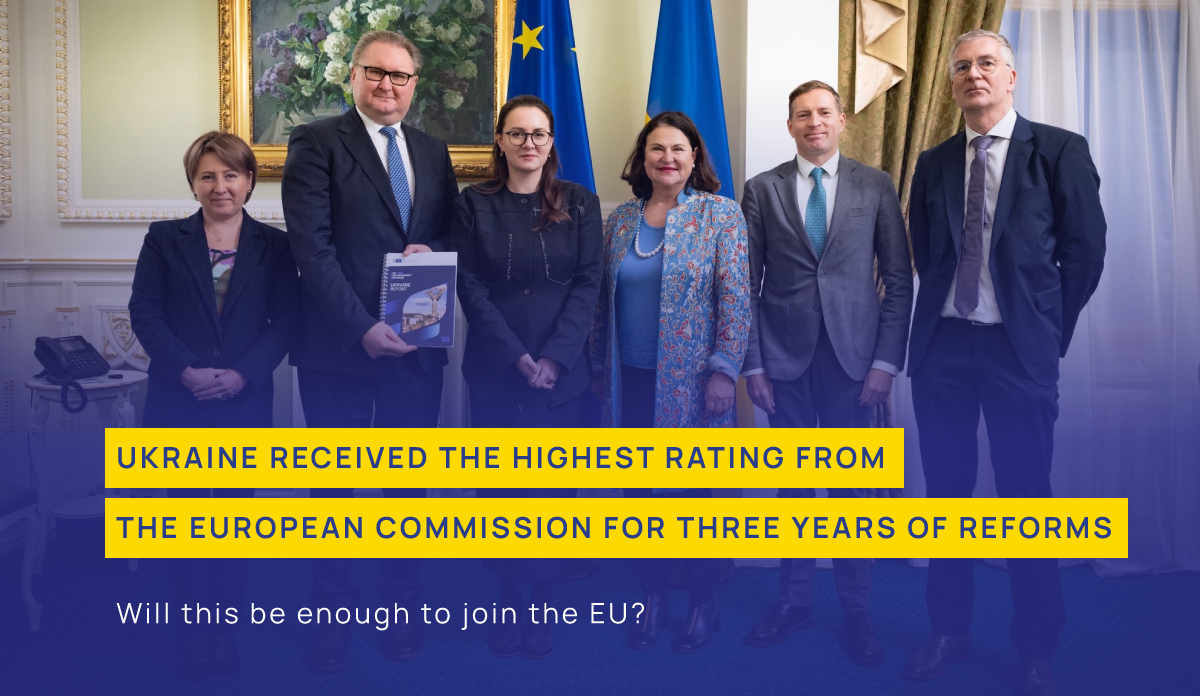
2025 was the year when Ukraine received the most favourable assessment of its progress in European integration reforms from the European Commission since it was granted candidate status – contrary to the frequent and far less optimistic forecasts of Ukrainian experts that had been heard on the eve of the assessment.
However, when a country joins the EU, it is not only the progress made over the last year that is important, but the cumulative progress over all the years, which allows us to talk about the country’s readiness to become a member of the EU. And what do we have here? Ukraine has demonstrated high cumulative scores in almost all negotiating chapters, such as customs union (4 points), external relations (4 points), information society and media (3.5 points), energy (4 points) and foreign, security and defence policy (4 points). It should be noted that reforms in most of the areas where we have been successful are related to technological changes in the relevant spheres of public life and the improvement of legislation on specific sectoral issues. However, none of the sectors in which Ukraine received high marks belong to the cluster of fundamental reforms (including democracy, the rule of law, public administration and anti-corruption), which is key to the negotiation process. Here, the score remains stable at 2 points.
According to a statement by Deputy Prime Minister for European Integration Taras Kachka, our country has set itself the ambitious goal of completing all European integration reforms by 2028 in order to be able to join the EU as early as 2030. To this end, in addition to implementing the entire body of EU legislation, Ukraine must carry out reforms that will guarantee the stability of democratic institutions, the rule of law and the ability of state institutions to ensure the effective implementation of pan-European policies.
Since the start of the full-scale invasion, Ukraine has demonstrated the remarkable resilience of its institutions. Our state bodies continue to operate under the most difficult conditions ever faced by EU candidate countries: regular air raid sirens and missile attacks, power cuts, and the loss of employees due to mobilisation and emigration. Despite all this, the state not only continues to function but is also capable of reform, even if the pace and regularity of these reforms are not always stable.
However, in the fourth year of the war, this resource of resilience is beginning to run out, and the EU must take this into account in its negotiations with Ukraine, as the classic mechanisms that the EU used in previous waves of enlargement will not work because the conditions are different. The parliament plays an important role in the accession process, as it is responsible for passing all the necessary legislation. In previous waves of enlargement, there was a normal democratic process with regular elections, when almost all parties — both ruling and opposition — understood the importance of accession and actively supported all European integration laws. Moreover, MPs were hardly involved in the negotiation process in order to avoid politicisation. Some countries agreed on negotiating positions only when political circumstances in the country required it, but this was not the case for all of them.
What do we have in Ukraine? Due to political stagnation and the absence of elections, we have a parliament that is losing MPs (currently 394, the lowest number in the history of Ukraine’s independence) and the desire for reform. This, incidentally, is noted in the European Commission’s report in the section on parliamentarism: ‘…the pace of adoption gradually slowed down over the course of the reporting period.’ But it is precisely the effective work of the Verkhovna Rada that is the key to the adoption of European integration laws, as well as the coordination and control of the executive branch’s efforts.
We understand perfectly well that elections are not possible in our circumstances. Our MPs are included in the negotiating working groups, something we have not seen in other countries that have joined the EU. We counted 35 of them. Most of them are already active in their work. However, the current mechanism for involving MPs in negotiations does not really encourage the passive majority to support European integration laws in parliament. A government of national unity does not seem like a realistic scenario for Ukraine either, although it would give new impetus to political processes. Parliament needs to feel important, and regular events and discussions involving European parliamentarians need to be held with MPs. Previously, there were Jean Monnet dialogues, which stimulated positive European integration processes in the parliament. It is important to resume them. Another important tool is friendship groups on development of interparlementairy relations with EU member states. These groups promote the development of parliamentary diplomacy, and it is very important for the negotiation process that members of the German Bundestag or the French Senate are on friendly terms with our MPs and have a clear understanding of what is happening with European integration laws. These friendship groups can be very helpful in the next stages of the negotiation process, when we will need the support of individual EU member states.
Another important institution for negotiations is the government, which must have sufficient personnel, competencies and resources to go through the negotiation process and defend the country’s interests where necessary. For former candidate countries, the biggest problem was changes in the government, as negotiations then came to a technical standstill. In Ukraine, this is not the biggest problem. We are seeing a blurring of the mechanisms of power distribution in the country. The Government, which according to the Constitution is accountable to the Verkhovna Rada, is showing less interest in interacting with Parliament, instead demonstratively reporting to the Office of the President.
What can and should be done with the government machine during the war? We have been writing about this for a long time – it is the reform of public administration. This is one of the important pillars on which the negotiation process can and should be based. European partners should pay attention to this reform and make it a priority. Its implementation will require funds, but if it is not started now, Ukraine will face the problem of implementing the norms that will be adopted during the negotiation process in the future, as civil servants are being washed out of the system.
We can already start candidate selection competitions for civil service positions, thus opening up the possibility of attracting professionals to the system. The professional and high-quality selection of officials is the basis for building an effective state. Evidence-based policy begins with effective public administrators (evidence-based policy occurs when management and political decisions are made on the basis of a thorough analysis of evidence and facts). We still need technocrats to carry out reforms in most of the negotiating chapters.
Another unique pillar of Ukrainian democracy during the war is a strong civil society. The events of July this year clearly demonstrated its role. In other candidate countries, civil society did not play such a role. Ukrainian civil society (which may also include intellectual, business and scientific elites) needs to consolidate and support each other, despite all the difficulties it has faced over the past year. European partners should support it both financially and politically, given the persecution faced by some anti-corruption organisations. Incidentally, the European Commission’s report mentions political pressure on anti-corruption activists and investigative journalists, as well as the arrests of NABU employees.
Finally, European enlargement policy can be an instrument of transformation for a candidate country, as in the case of recent enlargements, or it may not be, as in the case of the Western Balkans — a 20-year zone of uncertainty. Ukraine is a unique case that requires new approaches, as the risks here are greater and the usual technocratic approach used in negotiations may negate the influence of political levers and instruments that encourage candidate countries to reform. EU member states should pay attention to this, as they have the final say in all key decisions on enlargement.
 |
Authors
Liubov Akulenko, Executive director Dmytro Naumenko, Senior Analyst Oleksandra Bulana, Analyst |